Cold sores are tiny, fluid-filled blisters that are caused by the herpes simplex virus.
They appear on:
- the face - most often on the lips
- the genitals, in adults
Cold sores are common and usually clear up on their own within 10 days. They do not leave a scar.
Most people are exposed to the cold sore virus when they are young after close skin-to-skin contact with someone who has a cold sore.
Be careful not to spread cold sores, especially around babies and children. It can be fatal to newborn babies.
Check if it’s a cold sore
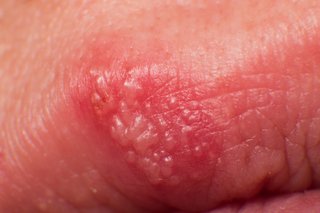
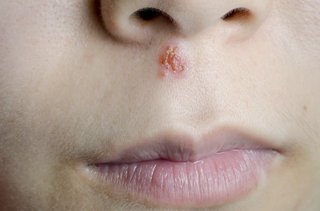
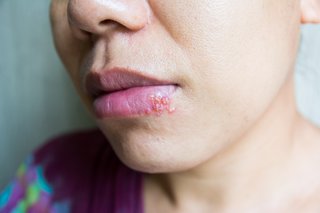
Small, fluid-filled blisters are the main symptom of cold sores in adults and children.
Adult symptoms
A cold sore usually start with a tingling, itching or burning feeling.
Over the next 48 hours, blisters may appear, leak fluid and usually crust over into a scab.
Child symptoms
Your child may have clusters of blisters inside and outside their mouth and on their tongue.
Cold sores can spread to your child’s:
- fingers if they suck their fingers
- eyes if they touch an open sore and then rubs their eyes
Other symptoms in your child include:
- sore gums and throat
- swollen glands
- more saliva than normal
- a high temperature
- headaches
- refusing to drink fluids
See what cold sores look like
Dangers to children and babies
Cold sores can be fatal to newborn babies and dangerous for older babies or children.
Do not kiss babies if you have a cold sore. It can lead to neonatal herpes.
Cold sores can cause complications for older babies and children, such as inflammation of the brain (encephalitis). But this is rare.
Emergency action required: Call 112 or 999 or go to your nearest emergency department (ED) if
your baby or child has a cold sore and:
- is confused
- has difficulty speaking
- has difficulty waking up or is very drowsy
- has behaviour changes, such as being very irritable
- is floppy and unresponsive
- has difficulty breathing, breathes faster or makes grunting noises
- has a blue tongue and skin (cyanosis)
- has a seizure (fit)
These are symptoms of encephalitis.
Caring for your baby if you have a cold sore
There are things you can do if you think you have or are about to develop a cold sore.
Do
-
wash your hands before contact with your baby
-
cover up cold sores before breastfeeding
Don't
-
do not kiss your baby when you have a cold sore
-
do not touch your cold sore and then your breast when breastfeeding
Treating cold sores at home
There are things you can do at home to treat cold sores and avoid spreading the virus:
Do
-
drink lots of fluids
-
eat cool, soft foods
-
wash your hands often with soap and warm water
-
wash your child’s clothes separately if they have a cold sore
-
avoid anything that triggers your cold sores
-
use sunblock lip balm (SPF15 or above) if you're outside in the sun
-
take paracetamol or ibuprofen to ease pain and swelling (liquid paracetamol is available for children) - do not give aspirin to children under age 16
Don't
-
do not touch cold sores – except when you put on cold sore creams
-
do not share anything that comes into contact with cold sores – such as cold sore creams, cutlery and towels
-
do not kiss anyone while you have a cold sore
-
do not let people with a cold sore kiss your baby or child
-
do not eat salty, citrus or acidic foods (these can make your blisters sting)
Non-urgent advice: Contact your GP if:
- you or your child’s cold sore has not started to heal within 10 days
- you're worried about a cold sore or think it's something else
- the cold sore is very large or painful
- your child gets a cold sore on their eyelid or around their eyes
- you or your child has swollen, painful gums and sores in the mouth (gingivostomatitis)
- you're pregnant – there's an increased risk of neonatal herpes
- you have a weak immune system
- you or your child’s cold sores keep coming back
Cold sores can sometimes be diagnosed and treated by a pharmacist through the Common Conditions Service. There is a fee for this service.
Get help from your pharmacist or GP
Your pharmacist can recommend some medicines without a prescription, including:
- creams to ease pain and irritation
- cold sore patches to protect the skin while it heals
They can also prescribe antiviral creams.
Use antiviral creams as soon as you feel a cold sore coming on. They do not always work after blisters appear.
Your GP might prescribe antiviral tablets if the cold sores are very large, painful or keep coming back.
Childcare, school and contact play
Your child can usually continue going to childcare and school if they have a cold sore and they feel well.
But they should avoid close contact with other children until their cold sore heals completely.