
If you suspect an overdose or drug emergency:
- Call the emergency services on 112 or 999.
- Check that the area is safe.
- Check the person.
- Do basic first aid and support the person until help arrives.
Call the emergency services
Call 112 or 999 and tell the operator that you suspect an overdose. Use the speaker phone function in case the operator asks you to do something.
You can call even if you are not sure. Medics would rather be called out to find an honest mistake than be too late to save a person's life.
Tell the operator everything that you know about:
- the person - for example, if they have medical conditions
- drugs the person may have taken
- the situation - what happened and how the person is responding
- where you are - give them the Eircode if possible
This will help the medics to give the right treatment. The most important thing for all emergency services is to save the person's life.
The operator will explain what to do while you wait for help to arrive. For example, how to do CPR or use naloxone. They can also tell you if there is an automated external defibrillator (AED) nearby.
Check that the area is safe
Before you try to help the person, make sure there are no harmful objects around them. For example, needles or broken glass.
Do not touch any harmful objects if you see them. Try to approach the person from another side.
Check the person
Check if the person responds to:
- sound - shout their name if you know it or ask them if they are OK
- touch - tap their shoulders
If the person does not respond, place them on their back. Gently tilt their head back and lower their chin. This opens their airway.
Check if the person is breathing.
You could:
- listen for breathing sounds
- see if their chest moves - if you put your hand over their chest, you can see any movement better
First aid and supporting the person
How to support the person while you wait for help depends on the situation.
If the person:
- is breathing but unconscious - put the person in the recovery position
- is not breathing - give CPR
- took opioids - give naloxone if available
- is hot, agitated or took stimulants - try to calm and cool the person
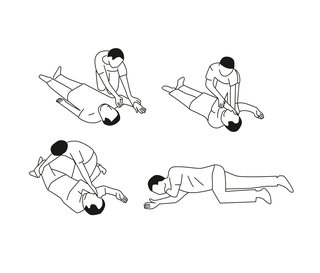
Put the person in the recovery position
Use the recovery position if the person is breathing but unconscious or unresponsive.
Make sure the person is lying flat on their back with their legs straight. Kneel by their side.
- Put the elbow closest to you in line with their shoulder with the palm of their hand facing up.
- Take their other arm and put the back of the hand against the cheek closest to you. Keep holding the hand against their cheek.
- Lift the back of the knee that is farthest away from you.
- Carefully pull the bent knee towards you and position the leg at a right angle.
- Gently tilt the person’s head back and lift their chin. This keeps their airway open.
If you cannot put the person in the recovery position, put them on their side.
Give CPR if the person is not breathing
Cardiopulmonary resuscitation (CPR) can help keep oxygen and blood moving through the body. You do it if the person's heart stops or they stop breathing.
Types of CPR are:
- chest compressions (hands-only CPR)
- chest compressions with rescue breaths
The emergency operator can guide you on when and how to give CPR.
Doing chest compressions
Before you start chest compressions, put the person on their back and kneel next to them.
To do a chest compression:
- Put the heel of your hand on the breastbone at the centre of the person's chest.
- Put the palm of your other hand on top of the hand on their chest. Interlock your fingers.
- Position your shoulders directly above your hands.
- Use your body weight to press straight down on the person's chest. Their chest should move by 5cm to 6cm.
- With your hands in the same position, stop pressing. The person's chest should return to its original position.
Do 100 to 120 compressions a minute. Do this until the person starts breathing or help arrives.
Doing chest compressions with rescue breaths
You can do chest compressions with rescue breaths if you had training in CPR or you feel comfortable. You can use a face mask if one is available.
To give a rescue breath:
- Gently tilt back the person's head and lift their chin.
- Pinch the person's nose.
- Seal your mouth over their mouth and blow into their mouth for about 1 second. Check that their chest rises.
Do 2 rescue breaths after every 30 chest compressions. Do this until the person starts breathing or help arrives.
Give naloxone
Naloxone is a medicine that can reverse the effects of opioids.
If you suspect an opioid overdose, check if the person has a naloxone kit with them. The kit has instructions on how to use it.
Naloxone does not work for other types of drugs. But it is safe to use naloxone even if you are not sure that the person has taken opioids.
In an emergency, anyone can give naloxone.
Try to calm and cool the person
If the person is agitated and hot, you could try to:
- talk to them in a calm and reassuring way
- go with them to a calmer area away from noise, crowds or bright lights if you can
- remind them that they are safe and that help is on the way
- suggest that they lie down or close their eyes if it is safe to do that
- offer them a glass of water to drink in small sips
- place a wet cloth or t-shirt on their forehead - you could also put it under their armpits or behind their knees
- listen if they tell you what they are experiencing - avoid dismissing them or disagreeing with them
Stay with the person
Stay with the person until help arrives. Keep checking that they are breathing.
Don't
-
do not try to make the person vomit
-
do not give the person anything to eat
-
do not give the person any other drugs
-
do not put the person in a cold shower or bath
When the medics arrive:
Do
-
tell them everything you know about the drug
-
give them any of the drug that is left
-
give them any used naloxone kits
-
tell them if there are needles nearby
-
tell them if the person has any medical conditions or if they are pregnant or breastfeeding