Scoliosis is where the spine twists and curves to the side.
It can affect people of any age, from babies to adults. It most often starts in children age 10 to 15.
Scoliosis is not usually a sign of anything serious. It's usually not painful. But the impact on the spine and posture can be noticeable. The twist in the spine can look like an 's' or 'c' shape.
Scoliosis can improve with treatment, but treatment may not be needed if it's mild.
Symptoms of scoliosis
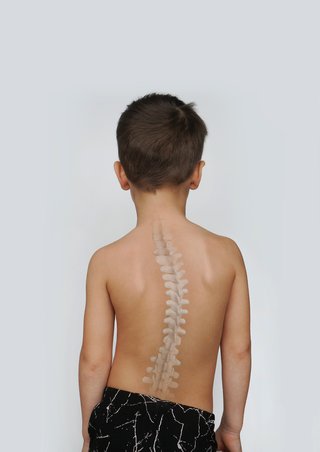
Signs of scoliosis include:
- uneven shoulders, waistline or hips
- 1 shoulder sticking out more than the other
- the ribs sticking out on 1 side
- leaning to 1 side
- a visibly curved spine
- clothes not fitting well
Symptoms of scoliosis can depend on how severe the curve of the spine is.
If scoliosis is mild, the signs may not be obvious.
When to see a GP
Contact a GP if you think you or your child has scoliosis. It's unlikely that there's anything seriously wrong, but it's best to get it checked out.
If the GP suspects scoliosis they may arrange an x-ray and refer you to an orthopaedic consultant.
Early diagnosis of scoliosis is important. Treatment can stop the condition from getting worse.
Tests to diagnose scoliosis
You or your child will be seen by an orthopaedic consultant if your GP thinks they may have scoliosis.
They'll usually carry out physical and imaging tests.
Physical tests include:
- posture assessment
- Adam’s forward bend test
Posture assessment
The specialist will examine you or your child’s shoulders, hips, and spine alignment. This is to see if anything is uneven.
Adam’s forward bend test
You or your child will bend forward at the waist with arms hanging freely. The specialist will look for any unevenness in the ribs or back. If they are uneven, this may indicate a spinal curve.
X-ray
If the specialist suspects that your child has scoliosis, they'll send you for an x-ray. This is to confirm the diagnosis and measure the spinal curve.
Treatments for scoliosis
The type of treatment you'll have for scoliosis depends on:
- your age
- how severe the curve is
- if it affects your overall health
- if it's likely to get worse with time
Many people will not need any treatment. Only a small number will need to have surgery on their spine.
It's not clear if back exercises help improve scoliosis, but general exercise is good for overall health. There's no need to avoid exercise unless your doctor tells you to.
Babies and toddlers
Babies and toddlers may not need treatment as the curve might improve over time. A plaster cast or plastic brace may be fitted to their back to stop the curve getting worse as they grow.
Older children
Older children may wear a back brace to stop the curve getting worse. Sometimes surgery may be needed to control the growth of the spine.
Scoliosis in children - treatments
Adults
Adults may need treatment to relieve pain. This may include painkillers, spinal injections and, very occasionally, surgery.
Scoliosis in adults - treatments
Living with scoliosis
Most people with scoliosis are able to live normal lives and can do most activities, including exercise and sports.
The condition does not usually cause significant pain or any other health problems. It tends to stay the same after you stop growing. Contact a GP if it gets any worse.
Having scoliosis or wearing a back brace can be tough. It may cause problems with body image and self-esteem, particularly for children and teenagers.
You may find it useful to contact a support group, such as Scoliosis Awareness and Support Ireland.
These groups are a good source of information and support. They may be able to put you in touch with people in a similar situation to you.
Causes of scoliosis
In around 8 in every 10 cases, the cause of scoliosis is unknown. This is called idiopathic scoliosis.
Idiopathic scoliosis cannot be prevented and is not thought to be linked to things such as bad posture, exercise or diet.
But your genes may make you more likely to get it. Sometimes it runs in families.
Idiopathic scoliosis in children
How idiopathic scoliosis can affect children is related to the age they are when the condition develops.
Children age 0 to 3 years
The condition usually improves without treatment. It tends to affect boys more. It's known as infantile idiopathic scoliosis.
Children age 3 to 9 years
There is a high risk scoliosis will get worse. This is known as juvenile idiopathic scoliosis.
Children age 10 to 18 years
This is known as adolescent idiopathic scoliosis (AIS). It tends to affect more girls than boys.
Less common causes of scoliosis
Less commonly, scoliosis may be caused by:
- the bones in the spine not forming properly in the womb - this is called congenital scoliosis and is present from birth
- an underlying nerve or muscle condition, such as cerebral palsy or muscular dystrophy - this is called neuromuscular scoliosis
- wear and tear of the spine with age - this is called degenerative scoliosis, which affects older adults
- a specific underlying syndrome that often affects multiple parts of the body - this is called syndromic scoliosis