Different types of urinary catheter are used in different ways.
Your doctor or nurse will tell you:
- about your type of catheter
- the benefits and risks of the catheter
- how long the catheter will stay in
Living with a urinary catheter
Intermittent urinary catheters
Intermittent urinary catheters are the most common type.
Intermittent catheters are temporary. You remove them as soon as your bladder is empty. You usually use a new catheter each time.
Your doctor or nurse will:
- tell you when to use a catheter
- show you how to insert a catheter through your urethra (the tube that carries pee out of your body)
You can drain the pee into a toilet, container or bag attached to the catheter.
Indwelling urinary catheters
An indwelling catheter stays in place in the bladder.
Your doctor or nurse inserts the catheter through your urethra. There is a small balloon at the top of the tube. This stops the tube from falling out of your bladder. This type of catheter is sometimes called a Foley catheter.
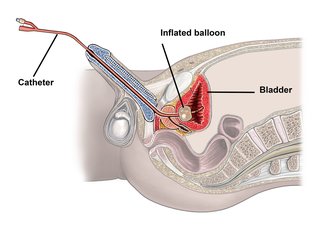
An indwelling catheter can have a:
- drainage bag that you strap to the inside of your leg or attach to a stand
- valve that you open over a toilet or container to drain your pee
A healthcare worker will change your indwelling catheter at least every 3 months. They will show you how to use and look after an indwelling catheter.
Suprapubic catheters
A suprapubic catheter (SPC) stays in place in your bladder. Your doctor inserts the catheter through a small hole under your belly button.
Your doctor may use an SPC if:
- your urethra is damaged or blocked
- you cannot use an intermittent catheter
An SPC can have a:
- drainage bag that you strap to the inside of your leg or tummy
- valve that you open over a toilet or container to drain your pee
You need to change an SPC every 6 to 8 weeks. Your nurse will do the first change.
If you need to use an SPC for a long time, they may show you or your carer how to change it.
Inserting a suprapubic catheter
The procedure is done in hospital.
You will have an anaesthetic so you do not feel anything. Your anaesthetist will explain the type of anaesthetic.
You may have a:
- general anaesthetic - where you are not awake for the surgery
- regional anaesthetic - an injection that numbs the area around your tummy
Your doctor may use a telescope or ultrasound to make sure the catheter is in the right position.
To insert the catheter, your doctor will:
- Clean the skin around your tummy.
- Make a small cut in your tummy below your belly button.
- Insert the catheter through the cut and into your bladder.
- Fill the balloon at the end of the tube with sterile water.
- Put a stitch by the cut to keep the tube in place.
- Put a waterproof bandage over the cut.
It may be possible to go home the same day as the procedure. But if your doctor needs to make a larger cut, you may need to stay in hospital for 1 or 2 days.
For the first few days, you will need to keep the waterproof bandage over the cut. Your doctor or nurse will tell you how to care for the cut.