
Your baby can choke on small bits of food, household items or small toys. They may put small objects in their mouth.
If your baby is choking, you may notice that:
- they appear to be crying or coughing but no sound is coming out - this is sometimes called a silent cough
- they are not able to cough
- their face may be pale
- their lips may be blue
- they are not able to breathe properly
Emergency action required: Call 112 or 999 immediately if:
- your baby is not conscious or is unresponsive
First aid for a baby (infant) who is choking
If your baby is conscious but they are not coughing effectively, you will need to give them first aid.
Step 1 - slap it out
Sit down. Hold your baby's face down on your forearm while resting your forearm on your knee. Make sure to support their head, jaw and neck. Their head should be lower than their body.
Give 5 back slaps using the heel of your other hand between your baby’s shoulders.
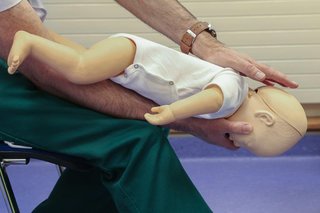
If you can see the object, try to remove it. But do not put your finger into your baby's mouth if you do not see anything there. This is because you could push the object further in.
If slapping it out does not work, move on to step 2.
Step 2 - squeeze it out
Turn your baby over so they are lying face up along your forearm while resting on your thigh. Make sure you support their head and neck.
Find their breast bone. This is in the centre of their chest, in line with their armpits.
Place 2 fingers in the middle of their chest and push sharply on the chest. Give 5 of these chest thrusts.
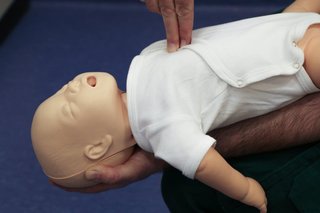
Emergency action required: Call 112 or 999 for emergency help if:
- your baby is still unable to cough
Step 3 - call 112 or 999
Keep doing 5 back slaps and 5 chest thrusts. Do this until the object pops out, the ambulance arrives or your baby becomes unresponsive.
Important
If your baby becomes unresponsive, you will need to begin cardiopulmonary resuscitation (CPR).
The emergency phone operator will guide you through how to give CPR.
If during CPR you see the object, remove it with your fingers. Do not place your fingers into your baby's mouth if you cannot see the object.
If the object comes out, you should still get medical help. This is in case part of the object remains or your child gets injured during the choking or first aid.
Anti-choking devices are not recommended
Do not use anti-choking devices if your child is choking. These are devices that clear the airway by using suction. There is not enough research on how well they work and how safe they are.
If you use an anti-choking device you could delay getting the correct treatment for choking.
Always follow the first aid steps if a baby under 1 is choking.
Baby and child first aid training
St John Ambulance provides information and courses about what to do if a baby or small child is choking.
What to do if your baby is choking (video)
Training in how to give basic first aid to babies and children is offered by the following organisations:
Irish Red Cross
Phone: 01 642 4600
Order of Malta Ireland
Phone: 01 643 0000
St John Ambulance Ireland
Phone: 01 668 8077
First aid apps
The St John Ambulance Ireland App is a free app for your phone.
CPR training
The Irish Heart Foundation offers certified training in CPR.
Learn more about CPR courses for the general public - irishheart.ie